What Is 3D? Definition, 2D vs 3D & How It Works
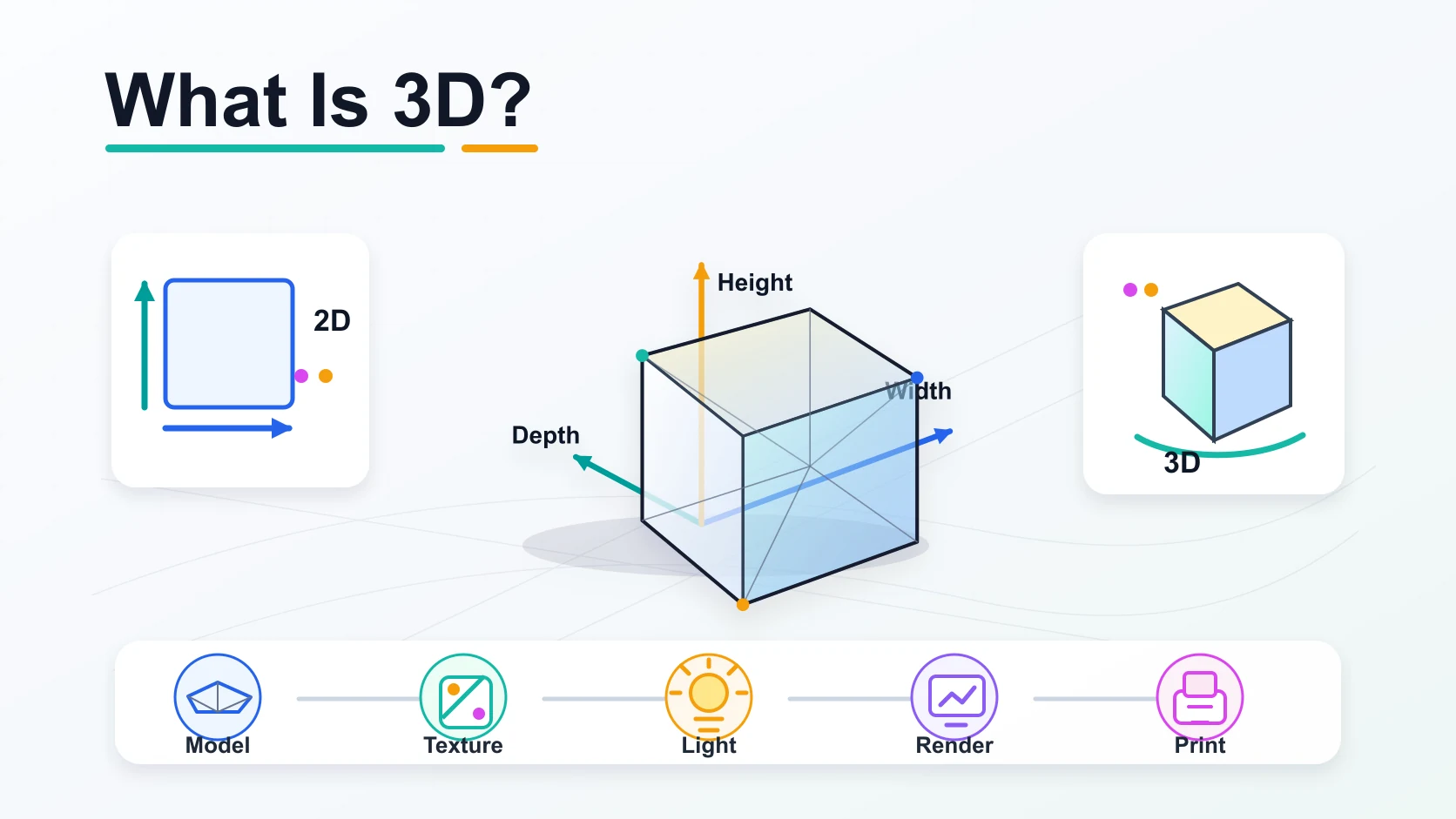
3D stands for "three-dimensional." It describes any object or space that has three measurements: width, height, and depth. Everything you can physically touch in the real world, from a coffee cup to a skyscraper, is three-dimensional, because it takes up volume and can be viewed from multiple angles.
Most online answers stop at that one-line definition. This guide goes further: how human depth perception works, the exact difference between 2D and 3D, every major type of 3D (shapes, modeling, printing, art, movies, gaming, and imaging), the industries built on it, a brief history, where AI is taking it next, and how you can start creating 3D content yourself. Last updated 2026-07-10.
What does 3D mean?
3D means three-dimensional. An object is three-dimensional when it extends across three spatial axes at once:
- Width (the X axis): how wide it is from left to right.
- Height (the Y axis): how tall it is from top to bottom.
- Depth (the Z axis): how deep it is from front to back.
Add those three together and you get volume, the amount of physical space an object fills. A flat photograph has width and height but almost no depth, so your brain reads it as two-dimensional (2D). A sculpture has all three, so it is 3D.
This is not just a label. The three dimensions are why you can walk around a car and see a new side each time, why a shadow falls differently depending on where light hits, and why a video game character looks correct from every camera angle. Depth is the dimension that makes objects feel real instead of flat.
Where the word shows up
"3D" gets used in several overlapping ways, and the overlap is what confuses people:
- 3D in the physical world: literally everything you can touch. Trees, phones, your own body. All three-dimensional.
- 3D in mathematics: solid geometric shapes with volume, like cubes, spheres, cylinders, and pyramids.
- Digital 3D (computer graphics): images and models generated in software that simulate depth on a flat screen, used in games, films, and virtual reality.
- 3D film (stereoscopic): a movie that tricks each eye into seeing a slightly different image so the picture appears to have depth, usually watched with special glasses.
When someone asks "what is 3D," they almost always mean the digital kind. The rest of this guide focuses there, because that is where modeling, rendering, and printing live.
2D vs 3D: what is the actual difference?
The difference comes down to one dimension: depth.
A 2D object has width and height only. A drawing, a photograph, and a shape printed on paper are all 2D. Their depth is so small relative to their other measurements that the brain does not register it. Mathematicians call the space they take up area.
A 3D object adds depth. A dice, a shoebox, and a 3D-printed figure all have width, height, and depth, so they occupy real space. The space they fill is called volume.
| Feature | 2D | 3D |
|---|---|---|
| Dimensions | Width and height | Width, height, and depth |
| Visual appearance | Flat | Has depth and volume |
| Viewable angles | One fixed viewpoint | Any angle, rotatable |
| Space occupied | Area | Volume |
| Typical examples | Drawings, photos, text | Sculptures, game characters, 3D prints |
| How it is created digitally | Camera capture or hand drawing | Built in 3D modeling software |
| Coordinate system | X and Y axes | X, Y, and Z axes |
In practice, the line blurs. A 3D rendering eventually gets flattened to a 2D image on your screen, and skilled 2D artists fake depth with shading and perspective. The distinction that matters for creators is whether an object is stored as a flat pixel grid (2D) or as a model with real geometric depth that can be rotated and relit (3D). For the formal mathematical treatment, three-dimensional space is defined as a space requiring three coordinates to locate a point.
How does 3D work?
3D works differently depending on whether you mean human perception or digital graphics.
Human depth perception
Your eyes see the world in 3D through stereoscopic vision. Each eye captures a slightly different 2D image because they sit a few centimeters apart. The visual cortex compares those two images, measures the differences, and reconstructs a sense of depth. This is why covering one eye makes it harder to judge how far away a cup is.
The brain also reads depth from non-stereoscopic cues: distant objects look smaller and move slower across your field of view, and an object that overlaps another reads as closer. These same cues are what 3D artists fake in software to make a flat render feel deep.
Digital 3D (computer graphics)
On a screen, 3D is an illusion built from math. Software represents an object as a 3D model: a collection of points (vertices), lines (edges), and surfaces (faces) defined in X-Y-Z coordinate space. To show that model on a flat monitor, a rendering engine projects the 3D geometry onto a 2D image, applying:
- Perspective projection: distant points shrink toward a vanishing point, mimicking how your eye sees.
- Lighting and shading: surfaces get brighter or darker based on their angle to a virtual light, which reveals form.
- Textures and materials: color, roughness, and reflectivity are mapped onto the geometry so it looks like metal, wood, or skin.
- Ray tracing (optional): the engine simulates how individual light rays bounce off surfaces, producing reflections, refractions, and shadows that match the physical world.
The result is a flat image that your brain reads as a real, three-dimensional object.
Stereoscopic 3D (movies and VR)
Stereoscopic 3D takes the illusion one step further by feeding each eye a separate image. 3D films shoot with two lenses spaced like human eyes, then polarize the two views so polarized glasses route one image to each eye. VR headsets do the same with two small screens, one per eye, updating the view as you turn your head. In both cases the brain merges the pair into perceived depth.
Types of 3D: the full landscape
"3D" covers a family of related disciplines. Here are the major types, what each one means, and where you encounter it.
3D shapes (geometry)
In math, 3D shapes are solid figures with volume. The common ones:
- Cube and cuboid: six square or rectangular faces.
- Sphere: every surface point equidistant from the center.
- Cylinder: two circular faces joined by a curved surface.
- Cone: a circular base tapering to a point.
- Pyramid: a polygon base rising to a point.
Each shape has measurable properties: volume, surface area, edges, vertices, and faces. 3D shapes are the geometric vocabulary underneath every video game level, architectural model, and 3D print.
3D modeling
3D modeling is the process of building a digital 3D object in software. The model is the raw geometry that everything else (texturing, animation, rendering, printing) builds on. There are several core techniques:
- Polygonal modeling: the most common method. The artist pushes and pulls vertices, edges, and faces (usually quads or triangles) to build a mesh. Used for almost all games and films.
- Digital sculpting: simulates working clay. The artist pushes, pulls, and smoothes a high-resolution surface to create organic shapes like characters and creatures. ZBrush popularized this.
- NURBS (curve-based modeling): uses mathematical curves and surfaces to define smooth, precise forms. Common in automotive and industrial CAD.
- Procedural modeling: the software generates geometry from rules and parameters, ideal for repeating structures like cities, forests, and terrain.
- Photogrammetry: reconstructs a 3D model from many photographs of a real object taken from different angles.
Increasingly, AI 3D generation can produce a usable model from a single image or text prompt, skipping much of the manual work. That is the category Trify3D belongs to.
3D printing
3D printing, or additive manufacturing, turns a digital 3D model into a physical object by depositing material layer by layer. The main technologies:
- FDM / FFF: melts and extrudes plastic filament, the most common consumer method.
- SLA and DLP: cures liquid resin with light for high-detail prints.
- SLS: fuses powder with a laser, used for durable production parts.
3D printing is used for prototypes, replacement parts, jewelry, dental molds, and increasingly end-use products. Every 3D print starts life as a 3D model, which is why modeling and printing are tightly linked.
3D art
3D art spans everything from traditional sculpture to fully digital work. In the digital realm, a 3D artist models, textures, lights, and renders a scene to produce still images or animation. The output can aim for photorealism (indistinguishable from a photograph) or a stylized look (cartoon, low-poly, cel-shaded). 3D art powers concept visualization, digital gallery pieces, album covers, NFT collections, and the visual identity of countless brands.
3D in movies and animation
Almost every modern blockbuster uses 3D. The roles:
- CGI (computer-generated imagery): 3D models rendered into shots, from a CGI character to an entire digital city.
- VFX (visual effects): 3D elements composited into live-action footage, including explosions, creatures, and set extensions.
- Full 3D animation: films built entirely in 3D software, like those from Pixar, Disney, and Illumination.
The 3D film "Avatar" (2009) is widely credited with pushing stereoscopic 3D cinema into the mainstream, while fully CGI features have used 3D modeling as their backbone since the 1990s.
3D gaming
Nearly all modern video games render their worlds in real-time 3D. A game engine takes the player's camera position and recalculates the scene dozens of times per second, so you can move through and look around a 3D environment freely. Game-ready 3D models are optimized: lower polygon counts, efficient textures, and rigged skeletons for animation. VR games push this further by rendering two views (one per eye) every frame.
3D imaging and visualization
A 3D image is a digitally constructed picture that simulates a three-dimensional object or scene. Unlike a photograph, which captures the physical world, a 3D image is built from a model, then rendered with realistic lighting and materials. Industries use 3D imaging for product visualization (showing a sofa in multiple colors without re-shooting it), architectural renders (selling an unbuilt apartment), and medical scans (turning MRI data into a viewable 3D volume). The advantage is total control: change the camera, the lighting, or the materials and re-render, with no physical reshoot.
How 3D content is created: the pipeline
Whether you are making a game character or a product render, most 3D work follows the same pipeline:
- Concept and reference. Sketches, mood boards, or reference photos pin down what the object should look like before any modeling starts.
- Modeling. The 3D model is built as a mesh (see what a mesh is in 3D modelling), either by hand (polygonal or curve modeling), by sculpting, procedurally, or now by AI from an image or prompt.
- UV mapping and texturing. The model's surface is unwrapped flat so 2D textures (color, roughness, bumps) can be painted or generated and wrapped back onto it.
- Rigging and animation (if needed). A skeleton is added so the model can move, then keyframes or motion capture drive the animation. If the model is for live streaming, rigged outfit and expression switches are called toggles — see what a toggle is on a 3D VTuber model.
- Lighting. Virtual lights are placed to shape the form and set the mood.
- Rendering. The engine bakes lighting, shadows, and materials into final images or frames. Ray-traced rendering looks most realistic; real-time rendering is fastest.
- Post-processing. Color grading, compositing, and effects polish the final output.
For 3D printing, the pipeline ends differently: the model is exported as an STL or OBJ file, sliced into layers in a printer driver, and sent to the printer instead of being rendered.
Industries that run on 3D
3D is not a niche. It underpins large parts of the modern economy:
- Film, TV, and animation: CGI characters, environments, and effects are standard in entertainment.
- Video games: every major title is built on real-time 3D.
- Architecture and real estate: unbuilt buildings are visualized and sold from 3D renders and walkthroughs.
- Product and industrial design: prototypes are modeled, tested, and marketed before physical production.
- Automotive and aerospace: vehicles are designed, simulated, and advertised using 3D models.
- Manufacturing: CAD models drive CNC machining and 3D printing for parts and tooling.
- Healthcare: CT and MRI scans are reconstructed into 3D volumes for diagnosis and surgical planning; patient-specific implants and prosthetics are 3D printed.
- Education and training: flight simulators, medical training, and interactive lessons rely on 3D.
- Virtual and augmented reality: VR and AR experiences are entirely 3D, from games to enterprise training to virtual try-on.
- E-commerce and marketing: product pages increasingly use 3D models and AR so shoppers can rotate and inspect items.
Wherever a team needs to visualize, prototype, or simulate a physical object before committing to the real thing, 3D is in the loop.
A brief history of 3D
3D technology is roughly a century old, with parallel development across film, computing, and printing:
- 1922. "The Power of Love," the first recorded 3D film, premieres using stereoscopic imaging and anaglyphic glasses.
- 1936. Polarized light is first demonstrated for 3D imagery using Polaroid filters.
- 1950s. Color 3D films like "Bwana Devil" popularize the red-and-blue anaglyphic glasses.
- 1960s. Ivan Sutherland's Sketchpad pioneers early computer graphics, laying groundwork for 3D CAD.
- 1981. Hideo Kodama develops an early additive 3D printing process using UV-cured resin. This additive manufacturing approach laid the groundwork for every modern 3D printer.
- 1986. Charles Hull patents stereolithography (SLA), the foundation of modern 3D printing.
- 1988. 3D Systems ships the first commercial SLA printer; Scott Crump files the patent for fused filament fabrication (FFF), today's most common consumer printing method.
- 1995. "Toy Story," the first fully computer-animated feature film, is released.
- 2000s. CAD and 3D modeling software become widely accessible; RepRap (2006) opens up low-cost 3D printing.
- 2009. Core FFF 3D printing patents expire, triggering a wave of affordable desktop printers.
- 2016. The Oculus Rift launches as the first major consumer VR headset.
- 2020s. Real-time ray tracing arrives in games and engines; AI image-to-3D and text-to-3D tools begin producing usable models from a single input.
The trajectory is consistent: each decade, 3D gets faster, cheaper, and more accessible, and AI is the latest step in that direction.
The future of 3D
Three forces are shaping what comes next.
AI-generated 3D. Models that once took a 3D artist days to build can now be generated from a single image or a text prompt in minutes. The quality still needs cleanup for production, but the floor keeps rising. This is the core shift Trify3D is built around.
Real-time everything. Real-time engines like Unreal and Unity can now render near-cinematic quality live, blurring the line between games and film and powering virtual production, live events, and collaborative 3D design.
Spatial computing and the metaverse. VR, AR, and mixed-reality headsets treat 3D as the native interface rather than a flat window. Whether or not a single "metaverse" materializes, demand for 3D content (avatars, environments, virtual products) is growing as the hardware improves.
The practical upshot: the cost of producing 3D content is falling fast, which means more of it, across more industries, created by more people.
How to start creating 3D
If you want to make 3D content yourself, the entry points depend on your goal:
- To learn traditional modeling, start with Blender (free, open source) or a free tier of a tool like Maya or ZBrush. Expect weeks of practice before your first clean model.
- To 3D print something, model it (or download one), export as STL, slice it in a printer driver, and print.
- To generate a model fast, use an AI 3D generator like Trify3D to turn a single image into a downloadable mesh in minutes, then refine it in Blender if you need production quality.
For most beginners, the fastest path is to generate a base model with AI, then learn just enough Blender to clean it up. You skip the steepest part of the learning curve and get a real result on day one.
What this means for you
3D started as a way to describe the physical world and grew into the backbone of how we design, prototype, and entertain. The definition has not changed (three dimensions: width, height, depth), but the tools have gone from million-dollar film studios to a free app on your laptop, and now to an AI that can build a model while you wait.
If you are exploring 3D for a project, a product, or just curiosity, the barrier has never been lower.
Bring your idea into 3D with Trify3D
Trify3D turns a single image into a 3D model in minutes, so you can skip the blank-canvas modeling phase and start from a real mesh you can refine, render, or print. Upload a photo or a concept image and download a model you can open in Blender, drop into a game engine, or send to a 3D printer.
To go deeper, you can learn how to generate 3D from an image, turn a 2D picture into 3D, make a 3D model from scratch, create clean textures for your models, export in the right format, or compare the best AI 3D model generators on the market.
Frequently asked questions
These are the questions Google surfaces in its People Also Ask box for "what is 3D," answered directly.
What does 3D mean?
3D stands for "three-dimensional." It describes any object or space measured across three axes: width (left to right), height (top to bottom), and depth (front to back). Everything you can physically touch is three-dimensional. In computing, 3D also refers to computer graphics that simulate that depth on a screen.
What is 3D in simple words?
In simple words, 3D means something has three measurements instead of two. A flat picture has width and height (2D). A real object you can hold also has depth (3D). If you can walk around something and see it from different sides, it is three-dimensional.
Are we living in 4D or 3D?
We live in a three-dimensional spatial world: width, height, and depth. If you count time, physicists describe the universe as four-dimensional spacetime. But in design, gaming, and everyday language, "3D" refers to the three spatial dimensions we can see and measure.
How do you explain 3D to a child?
Tell a child that a drawing on paper is flat, with only up-and-down and left-and-right. A toy block is different because it also sticks out toward you, so you can pick it up and turn it around. Anything you can hold and look at from every side is 3D. Balls, boxes, and your own body are all 3D.
What is the difference between 2D and 3D?
2D objects have width and height only, so they look flat (a drawing, a photo). 3D objects add depth, so they have volume and can be viewed from multiple angles (a cube, a game character). Digitally, 2D images are captured or drawn, while 3D models are built in software and can be rotated, lit, and rendered from any viewpoint.
What is 3D modeling?
3D modeling is the process of creating a digital, three-dimensional object using specialized software. Artists build geometry from polygons, sculpted surfaces, curves, or procedural rules, then add textures and lighting and render a final image or animation. 3D models power games, films, architecture, product design, medicine, and VR.
What is 3D used for?
3D is used across nearly every industry: games and animation, architecture and real estate, product and automotive design, 3D printing and manufacturing, medical imaging, education and training, and virtual and augmented reality. Anywhere a team needs to visualize, prototype, or simulate a physical object, 3D is involved.
Is 3D the same as 3D printing?
No. 3D is the broad concept of three-dimensional objects and space. 3D printing is one application: an additive manufacturing process that builds a physical object layer by layer from a digital 3D model. Every 3D print starts as a 3D model, but most 3D models are never printed and stay digital for rendering, animation, or simulation.
Run it yourself in Trify3D
Keep reading from this topic
What Is a Mesh in 3D? Types & How It Works
A mesh in 3D modelling is the geometric skeleton of a 3D object, built from vertices, edges, and faces. Covers mesh types, creation, file formats, and uses.
GuidesWhat Is Meshmixer? The Free 3D Mesh Editor (2026 Guide)
Meshmixer is Autodesk's free 3D mesh editor for sculpting, repairing, and prepping STL/OBJ files. Learn what it does and the best 2026 alternatives.